
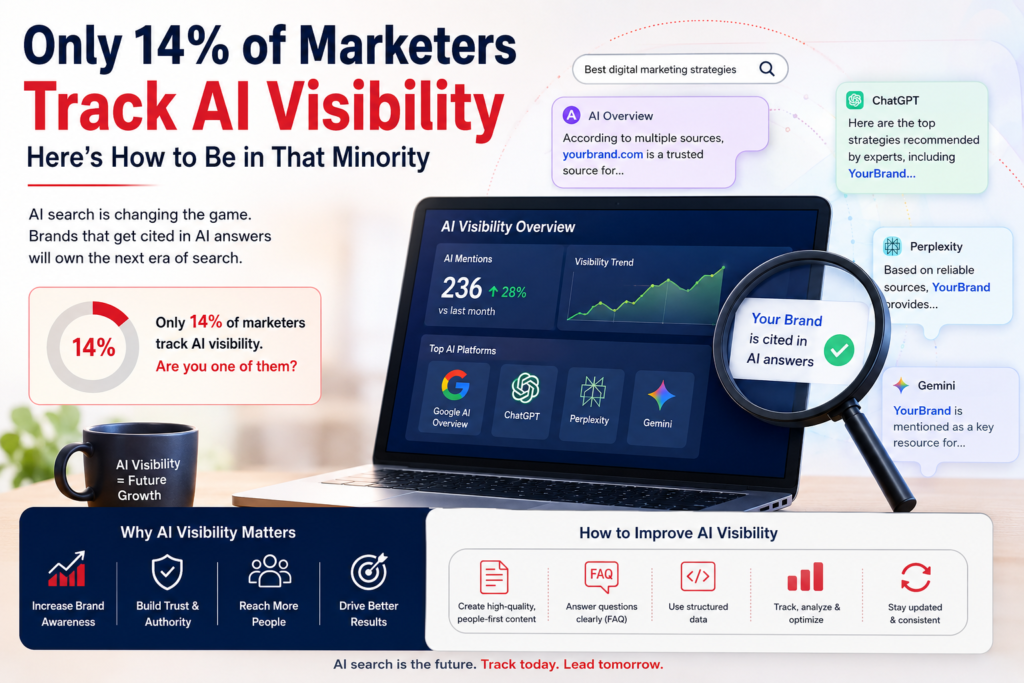
AI visibility, AI search visibility, AI citations, brand mentions in AI answers, and AI Overview tracking have become essential for businesses looking to grow online in 2026. Yet, according to recent industry research, only 14% of marketers actively track AI visibility across platforms such as Google AI Overviews, ChatGPT, Perplexity, and Gemini. This creates a significant opportunity for businesses willing to adapt early. While traditional SEO focuses on rankings and clicks, AI visibility focuses on whether your brand is cited, mentioned, and trusted by AI-powered search systems. Understanding this shift can help businesses increase brand awareness, authority, and long-term customer acquisition.
What Is AI Visibility and Why Does It Matter?
AI visibility refers to how often your brand, website, or content appears in AI-generated responses across search engines and AI assistants. Unlike traditional search rankings, AI visibility measures whether AI systems reference your content when answering user questions.
Today, users often receive answers directly from AI without clicking on a website. This means brands must focus on becoming trusted sources rather than simply achieving high rankings.
How AI Visibility Differs from Traditional SEO
Traditional SEO aims to achieve top positions on search engine results pages. AI visibility focuses on:
- Brand mention frequency
- Citation rates in AI answers
- Share of voice across AI platforms
- Presence in AI-generated recommendations
Example
A website may rank first on Google for a keyword but still fail to appear in an AI Overview. Conversely, a well-structured page ranking lower may be cited directly because it provides clear and authoritative information.
The Growing Impact of AI Search
AI-powered search platforms are changing how users discover information. Search experiences now include:
- Google AI Overviews
- ChatGPT Search
- Perplexity AI
- Gemini-powered results
As these platforms continue to expand, businesses that monitor AI visibility gain a competitive advantage over those relying solely on traditional SEO metrics.
Why Only 14% of Marketers Are Tracking AI Visibility
Despite the rapid growth of AI search, many marketers still focus exclusively on rankings, traffic, and backlinks.
Common Reasons Marketers Ignore AI Visibility
Lack of Awareness
Many businesses do not fully understand how AI-generated search results influence customer decisions.
Limited Tracking Tools
Traditional SEO platforms were designed to monitor rankings rather than AI citations and brand mentions.
Changing Search Behavior
Users increasingly receive complete answers without visiting websites, making older performance metrics less reliable.
The Opportunity for Early Adopters
Businesses that start tracking AI visibility today can:
- Identify new content opportunities
- Improve brand authority
- Gain visibility before competitors
- Adapt faster to future search changes
Why Timing Matters
The same businesses that invested early in SEO benefited from years of organic growth. AI visibility represents a similar opportunity in the next phase of search evolution.
How to Improve AI Visibility in 2026
Improving AI visibility requires a combination of strong content, technical SEO, and ongoing monitoring.
Create Content That AI Systems Prefer
AI platforms often cite content that is:
- Clear and concise
- Fact-based and authoritative
- Structured with headings and FAQs
- Updated regularly
Use Direct Answers
Answer important questions within the first few paragraphs of your content.
Include Original Insights
Research, surveys, case studies, and expert opinions help AI systems identify your content as trustworthy.
Optimize for AI Citations
Instead of focusing only on rankings, focus on becoming a reliable source.
Best Practices
- Add FAQ sections
- Use structured data markup
- Create topic clusters
- Include expert commentary
- Keep information updated
Build Topical Authority
AI systems favor brands that consistently publish content around specific topics.
For example, a digital marketing agency should create content covering:
- SEO
- AI SEO
- Content marketing
- Social media marketing
- Conversion optimization
The more comprehensive your expertise appears, the more likely AI systems are to cite your content.
How to Track and Measure AI Search Visibility
Tracking AI visibility helps businesses understand whether their optimization efforts are producing results.
Monitor AI Mentions Across Platforms
Regularly test important queries on:
- Google AI Overviews
- ChatGPT
- Perplexity
- Gemini
Track whether your brand appears and how competitors are represented.
Measure Key AI Visibility Metrics
Brand Mention Rate
How often your brand appears in AI-generated responses.
Citation Frequency
How frequently AI platforms reference your content as a source.
AI Share of Voice
The percentage of AI answers mentioning your brand compared to competitors.
Geo-Specific Visibility
Visibility for local searches and location-based queries.
Recommended AI Visibility Tools
Several tools now support AI visibility monitoring:
- Semrush
- Ahrefs
- Nightwatch
- Wincher
- BrightEdge
- Authoritas
Each platform offers different levels of AI search tracking depending on business size and budget.
Establish a Reporting Routine
A simple reporting process can help maintain consistency.
Weekly
- Check priority keywords
- Monitor competitor mentions
- Identify citation changes
Monthly
- Review AI visibility trends
- Compare citation growth
- Evaluate brand search volume
Quarterly
- Conduct competitive analysis
- Identify content gaps
- Update AI SEO strategy
Frequently Asked Questions
What is AI visibility in SEO?
AI visibility measures how often your content, brand, or website appears in AI-generated answers across platforms like Google AI Overviews, ChatGPT, Perplexity, and Gemini.
Does traditional SEO help improve AI visibility?
Yes. Strong technical SEO, quality content, topical authority, and structured information improve the likelihood of being cited by AI systems.
Which tools can track AI visibility?
Popular AI visibility tracking tools include Semrush, Ahrefs, BrightEdge, Authoritas, Nightwatch, and Wincher.
Conclusion
The fact that only 14% of marketers track AI visibility reveals a major opportunity for businesses willing to adapt. As AI-powered search becomes more influential, success will depend on more than rankings alone. Brands must focus on citations, mentions, authority, and trust across AI platforms.
By creating high-quality content, monitoring AI search presence, and building topical expertise, businesses can strengthen their visibility where future customers are increasingly finding answers.
Ready to Improve Your AI Visibility?
Start by identifying your top 20 target keywords, monitor how AI platforms respond to them, and optimize your content to become the trusted source AI systems choose to cite. The brands that act now will be better positioned to dominate AI search visibility in the years ahead.