
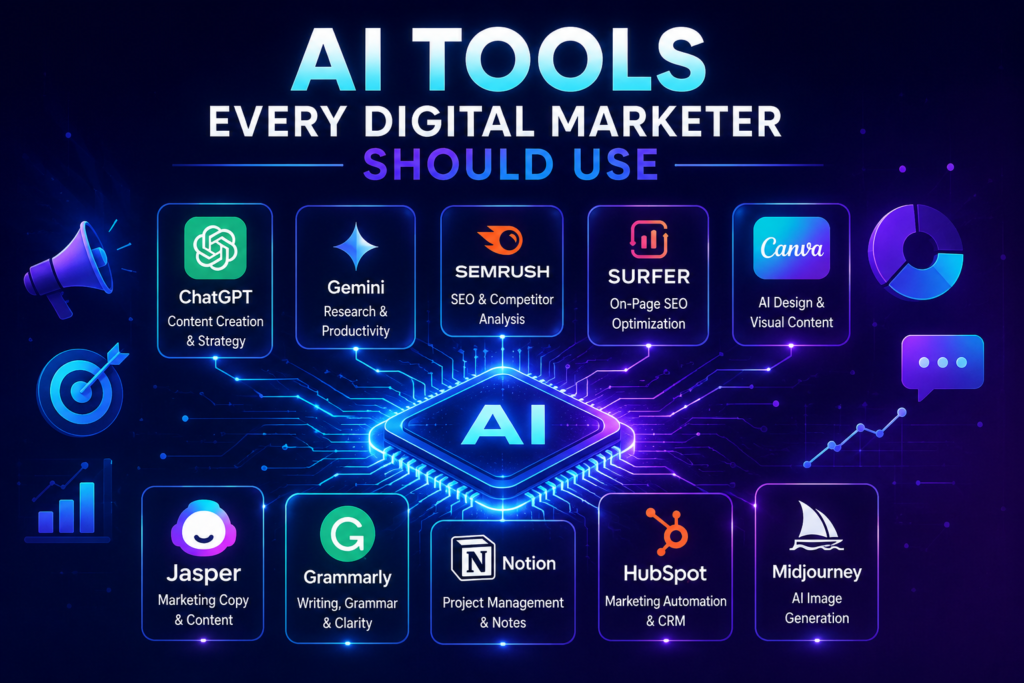
AI Tools Every Digital Marketer Should Use have completely transformed the way businesses attract customers, improve search rankings, create content, manage campaigns, and increase conversions. From automating repetitive tasks to generating data-driven insights, Artificial Intelligence is now helping marketers achieve better results with greater efficiency.
Whether you’re a beginner exploring digital marketing, a freelancer managing multiple clients, or an agency owner handling large-scale campaigns, choosing the right AI tools can save hundreds of hours every year while improving productivity and return on investment (ROI).
After working in SEO and digital marketing for more than a decade, one thing has become clear: AI doesn’t replace great marketers—it empowers them. The professionals achieving the best results today are those who combine AI-powered automation with strategic thinking, creativity, and real-world marketing experience.
This comprehensive guide explores the best AI tools every digital marketer should use, compares their features, explains their ideal use cases, highlights pricing, and shares practical workflows to help you build a smarter, more efficient marketing system.
Why Artificial Intelligence Is Revolutionizing Digital Marketing
Digital marketing has evolved far beyond publishing blog posts or running social media ads. Today, marketers must manage SEO, content marketing, paid advertising, analytics, email campaigns, customer engagement, lead generation, reporting, and conversion optimization—all while keeping up with changing algorithms and consumer expectations.
Artificial Intelligence helps simplify this complexity by automating repetitive work and supporting better decision-making.
How AI Helps Modern Marketers
AI-powered marketing tools can:
- Generate SEO-friendly content ideas
- Perform keyword research faster
- Optimize website content
- Create ad copy in seconds
- Design graphics automatically
- Analyze customer behavior
- Predict marketing trends
- Personalize email campaigns
- Automate repetitive marketing tasks
- Improve campaign performance with data-driven insights
Instead of replacing human expertise, AI allows marketers to spend more time on strategy, creativity, and business growth.
Why Every Digital Marketer Should Start Using AI Today
Businesses that embrace AI gain a competitive advantage by working smarter rather than harder.
Some of the biggest benefits include:
Faster Content Production
AI significantly reduces the time required to create blog outlines, product descriptions, ad copy, emails, and social media content.
Better Decision-Making
AI analyzes large datasets much faster than humans, helping marketers identify opportunities and trends.
Higher Productivity
Instead of spending hours on repetitive tasks, marketers can automate routine work and focus on growth strategies.
Improved Personalization
AI helps deliver personalized recommendations, emails, and customer experiences that improve engagement and conversions.
Cost Efficiency
Small businesses and startups can accomplish more with fewer resources by leveraging AI-powered automation.
AI Tools Comparison Table
Choosing the right AI tool depends on your marketing goals. Here’s a quick comparison to help you decide.
| AI Tool | Best For | Free Version | Starting Price* | Ease of Use | Overall Rating |
| ChatGPT | Content Creation & Strategy | ✅ Yes | From $20/month | ⭐⭐⭐⭐⭐ | ⭐⭐⭐⭐⭐ |
| Google Gemini | Research & Productivity | ✅ Yes | Advanced plans available | ⭐⭐⭐⭐⭐ | ⭐⭐⭐⭐☆ |
| Surfer SEO | Content Optimization | ❌ No | From $89/month | ⭐⭐⭐⭐☆ | ⭐⭐⭐⭐⭐ |
| SEMrush | SEO & Competitor Analysis | Trial | From $140/month | ⭐⭐⭐⭐☆ | ⭐⭐⭐⭐⭐ |
| Jasper AI | Marketing Copywriting | Trial | From $49/month | ⭐⭐⭐⭐⭐ | ⭐⭐⭐⭐☆ |
| Canva AI | Graphic Design | ✅ Yes | From $15/month | ⭐⭐⭐⭐⭐ | ⭐⭐⭐⭐⭐ |
| Grammarly | Editing & Proofreading | ✅ Yes | From $12/month | ⭐⭐⭐⭐⭐ | ⭐⭐⭐⭐☆ |
| Notion AI | Project Management | Add-on | Paid | ⭐⭐⭐⭐☆ | ⭐⭐⭐⭐☆ |
| HubSpot AI | CRM & Automation | Limited | Business Plans | ⭐⭐⭐⭐☆ | ⭐⭐⭐⭐☆ |
Note: Pricing is approximate and may change over time. Always check the official websites for the latest plans.
Which AI Tool Should You Choose?
Not every marketer needs every AI tool. The best choice depends on your goals, experience level, and daily workflow.
| If You Are… | Best AI Tool Combination |
| Beginner | ChatGPT + Canva AI |
| Blogger | ChatGPT + Surfer SEO |
| SEO Specialist | SEMrush + Surfer SEO |
| Freelancer | ChatGPT + Grammarly |
| Social Media Manager | Canva AI + ChatGPT |
| Agency Owner | HubSpot AI + SEMrush |
| Small Business Owner | Gemini + Canva AI |
| E-commerce Marketer | Jasper AI + HubSpot AI |
Expert Insight: Start with one or two tools and master them before expanding your AI stack. A focused workflow is usually more effective than juggling too many platforms.
Top AI Tools Every Digital Marketer Should Use
1. ChatGPT – The Ultimate AI Assistant for Digital Marketers
When it comes to versatility, ChatGPT remains one of the most valuable AI tools available. It acts as a brainstorming partner, content writer, research assistant, and marketing strategist—all in one platform.
Best For
- Blog writing
- SEO content planning
- Landing pages
- Product descriptions
- Email marketing
- Ad copy
- Keyword clustering
- Marketing strategy
- Customer support responses
Key Features
AI-Powered Content Creation
Generate first drafts, blog outlines, FAQs, and social media captions within minutes.
SEO Assistance
Create optimized headings, meta descriptions, keyword variations, and content briefs.
Campaign Ideation
Brainstorm creative campaign ideas, promotional offers, and content calendars.
Prompt-Based Flexibility
Unlike many specialized tools, ChatGPT adapts to almost any marketing task when provided with clear prompts.
Pros
- Easy to use
- Saves significant time
- Excellent for brainstorming
- Supports multiple content formats
- Great for marketers of all experience levels
Cons
- Requires human editing
- Can occasionally produce outdated or inaccurate information
- Should not be relied on for publishing without fact-checking
Expert Experience
In our SEO workflows, ChatGPT has dramatically reduced the time needed to create content outlines and first drafts. However, the highest-performing pages always combine AI-generated structure with human expertise, original examples, and real-world insights. This balance is essential for meeting Google’s E-E-A-T expectations and building trust with readers.
2. Google Gemini – Best for Research and Productivity
Google Gemini integrates seamlessly with Google Workspace, making it an excellent choice for businesses already using Gmail, Docs, Sheets, and Drive.
Best For
- Research
- Email writing
- Document creation
- Spreadsheet analysis
- Business productivity
- Content summarization
Key Features
Google Workspace Integration
Work directly within Google Docs, Gmail, and Sheets without switching between tools.
Research Support
Summarize long documents, compare information, and organize research efficiently.
Data Analysis
Identify trends and insights from spreadsheets to support marketing decisions.
Pros
- Smooth integration with Google’s ecosystem
- Strong research capabilities
- Helpful for collaborative teams
- Easy to learn
Cons
- Less specialized for advanced SEO than dedicated SEO platforms
- Some premium features require paid plans
Expert Tip
If your business relies heavily on Google Workspace, Gemini can streamline daily tasks and improve team productivity without disrupting existing workflows.
3. Surfer SEO – Best AI Tool for On-Page SEO Optimization
Creating content is only half the battle. To achieve strong search engine rankings, your content must align with what users are searching for and how search engines evaluate relevance.
Surfer SEO helps bridge this gap by analyzing top-ranking pages and providing actionable recommendations to optimize your content.
Best For
- On-page SEO
- Content optimization
- Semantic keyword analysis
- Competitor benchmarking
- Improving content relevance
Key Features
Content Score
Evaluates how well your article aligns with top-performing content in search results.
NLP Keyword Suggestions
Recommends semantically related terms to improve topical relevance.
Competitor Analysis
Highlights common patterns among high-ranking pages, including structure, keyword usage, and content depth.
Real-Time Optimization
Offers live recommendations as you write, making it easier to refine your content before publishing.
Pros
- Excellent for improving on-page SEO
- Data-driven optimization recommendations
- Supports content teams and agencies
- Helps identify content gaps
Cons
- Premium pricing may not suit every beginner
- Recommendations should complement—not replace—editorial judgment
Expert Experience
Across multiple SEO projects, Surfer SEO has consistently helped identify missing topical coverage and improve content structure. When combined with thoughtful editing and first-hand expertise, it becomes a powerful tool for creating content that serves both users and search engines.
4. SEMrush AI – The Complete SEO & Competitive Intelligence Platform
If you’re serious about improving your website’s organic visibility, SEMrush is one of the most comprehensive AI-powered SEO platforms available. It combines keyword research, competitor analysis, backlink monitoring, technical SEO, and AI-driven content recommendations into a single platform.
Unlike tools that focus on only one aspect of SEO, SEMrush provides a complete picture of your website’s performance and helps prioritize tasks that can deliver the greatest impact.
Best For
- Keyword research
- Competitor analysis
- Website audits
- Backlink analysis
- Rank tracking
- Content optimization
- Local SEO
- PPC research
Key Features
AI Keyword Research
Discover high-volume, low-competition keywords that align with your business goals.
Competitor Analysis
Understand which keywords your competitors rank for, where they earn backlinks, and how their content performs.
Technical SEO Audit
Identify broken links, crawl issues, duplicate content, slow-loading pages, and other technical problems affecting rankings.
AI Writing Assistant
Improve readability, keyword usage, tone, and SEO optimization while creating content.
Pros
- Complete SEO solution
- Industry-leading competitor analysis
- Accurate keyword database
- Powerful reporting dashboard
- Excellent for agencies and businesses
Cons
- Premium pricing
- Learning curve for beginners
- Some advanced reports require higher-tier plans
Expert Experience
In client SEO campaigns, SEMrush is often the first tool used during project planning. Before creating content, we analyze competitor rankings, identify keyword gaps, and evaluate backlink opportunities. This research-first approach leads to more strategic content decisions and stronger long-term SEO performance.
5. Canva AI – The Best AI Design Tool for Marketers
Digital marketing isn’t only about writing—it also requires engaging visuals. Canva AI makes professional graphic design accessible to everyone, even without prior design experience.
From blog graphics and social media posts to presentations and YouTube thumbnails, Canva AI helps marketers create polished visuals in minutes.
Best For
- Social media graphics
- Blog featured images
- Presentations
- Infographics
- Marketing materials
- YouTube thumbnails
- Advertisements
Key Features
Magic Design
Automatically generates design layouts based on your content or prompt.
AI Image Generation
Create original visuals using text prompts for blogs, ads, and campaigns.
Background Remover
Remove image backgrounds instantly for cleaner, more professional designs.
Brand Kit
Maintain consistent fonts, logos, and colors across all marketing assets.
Pros
- Beginner-friendly interface
- Thousands of ready-made templates
- AI-powered design assistance
- Excellent collaboration features
Cons
- Some advanced features require Canva Pro
- Limited compared to professional software like Adobe Creative Cloud
Expert Tip
Consistent branding builds trust. Use Canva’s Brand Kit to ensure every graphic reflects your brand identity across all platforms.
6. Jasper AI – Specialized AI for Marketing Copy
Jasper AI is designed specifically for marketers who create persuasive sales and advertising copy. It focuses on conversion-oriented writing rather than general-purpose content.
Best For
- Sales pages
- Landing pages
- Facebook Ads
- Google Ads
- Email campaigns
- Product descriptions
- Marketing copy
Key Features
Brand Voice
Train Jasper to write in your company’s preferred tone and style.
Campaign Templates
Generate ad copy, headlines, CTAs, and promotional emails quickly.
Marketing Workflows
Streamline repetitive copywriting tasks for campaigns across multiple channels.
Pros
- Excellent for persuasive writing
- Consistent brand messaging
- Time-saving templates
- Strong collaboration features
Cons
- Less flexible than ChatGPT
- Subscription costs may be high for solo marketers
7. Grammarly AI – Improve Writing Quality and Professionalism
High-quality content isn’t just about ideas—it also needs to be clear, error-free, and easy to read. Grammarly AI acts as a writing assistant that improves grammar, tone, clarity, and readability.
Best For
- Blog editing
- Email communication
- Client proposals
- Website copy
- Reports
- Social media captions
Why It Matters
Even minor grammatical mistakes can reduce credibility. Grammarly helps ensure your content reflects professionalism and builds trust with readers.
Pros
- Real-time grammar correction
- Tone suggestions
- Readability improvements
- Browser integration
Cons
- Premium features require a subscription
- May occasionally recommend changes that alter intended meaning
8. Notion AI – Organize Marketing Projects Efficiently
Marketing teams often manage multiple campaigns, content calendars, client projects, and meeting notes simultaneously. Notion AI simplifies project management by combining documentation with intelligent automation.
Best For
- Content planning
- SOP documentation
- Campaign management
- Team collaboration
- Knowledge bases
Expert Tip
Create a centralized content calendar in Notion AI where your entire marketing team can collaborate, assign tasks, and monitor campaign progress in one place.
9. HubSpot AI – Smarter Marketing Automation
HubSpot AI combines customer relationship management (CRM) with AI-powered automation to improve lead nurturing, email marketing, and customer engagement.
Best For
- CRM
- Lead generation
- Email marketing
- Marketing automation
- Sales enablement
- Customer service
Key Features
AI Email Writing
Generate personalized email campaigns quickly.
Lead Scoring
Identify high-value prospects using predictive insights.
Marketing Automation
Automate repetitive workflows to improve efficiency.
Pros
- Powerful all-in-one platform
- Excellent CRM integration
- Scalable for growing businesses
Cons
- Higher pricing than standalone tools
- Advanced features require premium plans
10. AI Image Generation Tools (Mid journey & DALL·E)
Visual storytelling has become a crucial part of digital marketing. AI image generators help businesses create unique graphics without relying solely on stock photography.
Best For
- Blog illustrations
- Social media posts
- Ad creatives
- Product concepts
- Website banners
- Presentation visuals
Why They’re Valuable
Custom visuals improve brand recognition and often generate higher engagement than generic stock images.
AI Tools Pricing Comparison
Understanding pricing helps you choose tools that match your budget and business needs.
| AI Tool | Free Plan | Starting Paid Plan* | Best For |
| ChatGPT | ✅ Yes | From $20/month | Content & Strategy |
| Google Gemini | ✅ Yes | Advanced plans available | Research |
| Canva AI | ✅ Yes | From $15/month | Graphic Design |
| Grammarly | ✅ Yes | From $12/month | Writing |
| Jasper AI | Trial | From $49/month | Marketing Copy |
| Surfer SEO | ❌ No | From $89/month | SEO |
| SEMrush | Trial | From $140/month | Complete SEO |
| Notion AI | Add-on | Paid | Productivity |
| HubSpot AI | Limited | Business Plans | CRM |
Pricing Disclaimer: Subscription costs may vary based on region, promotions, and feature updates. Always verify current pricing before purchasing.
My Proven AI Workflow for Digital Marketing
One of the biggest mistakes marketers make is relying on a single AI platform for every task. In practice, the most effective results come from combining specialized tools into a streamlined workflow.
Step 1 – Keyword Research
Use SEMrush to discover high-intent keywords, competitor gaps, and trending topics.
Step 2 – Content Planning
Create detailed outlines, FAQs, and content briefs using ChatGPT.
Step 3 – SEO Optimization
Refine the draft with Surfer SEO, adding semantic keywords, improving heading structure, and optimizing topical relevance.
Step 4 – Visual Design
Create featured images, infographics, and social media creatives using Canva AI.
Step 5 – Proofreading
Run the final draft through Grammarly AI to improve grammar, clarity, and tone.
Step 6 – Publishing & Performance Tracking
Monitor rankings, backlinks, and website performance using SEMrush while refining content based on real user data.
Why This Workflow Works
Rather than expecting one tool to do everything, each platform contributes where it performs best. This layered approach improves quality, saves time, and creates content that is both user-friendly and search-engine optimized.
Mini Case Study: How AI Improved Our Content Workflow
The Challenge
Managing multiple SEO projects while maintaining content quality and publishing consistency became increasingly difficult as workloads grew.
The Solution
We introduced an AI-assisted workflow:
- SEMrush for keyword research
- ChatGPT for outlining and first drafts
- Surfer SEO for optimization
- Canva AI for visual assets
- Grammarly for editing
The Outcome
Within a few months, the team observed:
- Approximately 45% faster content production
- More consistent publishing schedules
- Better topical coverage across articles
- Improved editorial efficiency
- Higher-quality content through structured human review
Key Lesson: AI accelerated the process, but human expertise remained essential for strategy, fact-checking, and creating genuinely helpful content.
Common Mistakes Digital Marketers Make with AI
Publishing AI Content Without Editing
AI-generated drafts should never be published without reviewing facts, refining language, and adding original insights.
Ignoring Search Intent
Ranking isn’t about keywords alone. Content must answer the user’s actual questions and solve real problems.
Depending on One AI Tool
No single platform excels at every task. Combining specialized tools typically delivers better results.
Losing Brand Voice
Every business has a unique personality. Customize AI-generated content to reflect your brand’s tone and messaging.
Forgetting Human Creativity
AI can generate ideas, but emotional storytelling, strategic thinking, and relationship building remain uniquely human strengths.
Expert Recommendation
After more than a decade of working in SEO and digital marketing, my recommendation is simple: don’t chase every new AI tool. Instead, build a reliable toolkit around your goals. For most marketers, ChatGPT, SEMrush, Surfer SEO, and Canva AI provide an excellent foundation. Master these tools, combine them with your expertise, and continuously test what works for your audience. AI should enhance your skills—not replace your judgment.
Frequently Asked Questions (FAQs)
1. What are the best AI tools every digital marketer should use?
The best AI tools depend on your marketing goals. For most professionals, ChatGPT is ideal for content creation, SEMrush for SEO and competitor research, Surfer SEO for content optimization, Canva AI for design, Grammarly for editing, and HubSpot AI for marketing automation. Together, these tools create a well-rounded AI-powered marketing workflow.
2. Can AI replace digital marketers?
No. AI is designed to assist marketers rather than replace them. It automates repetitive tasks such as content drafting, keyword analysis, and reporting, but human creativity, strategic thinking, customer understanding, and decision-making remain essential for successful digital marketing.
3. Which AI tool is best for SEO?
For SEO professionals, SEMrush and Surfer SEO are among the best choices. SEMrush helps with keyword research, competitor analysis, backlink tracking, and technical SEO, while Surfer SEO improves on-page optimization using data from top-ranking pages.
4. Is ChatGPT enough for digital marketing?
ChatGPT is an excellent starting point for brainstorming, content creation, and campaign planning, but it works best when combined with specialized tools for SEO, analytics, graphic design, and automation. A combination of AI tools generally delivers stronger results than relying on a single platform.
5. Can AI-generated content rank on Google?
Yes, AI-assisted content can rank well if it is original, accurate, and genuinely helpful. Google’s focus is on the quality and usefulness of the content rather than whether AI was involved. The strongest-performing articles combine AI-generated drafts with human expertise, fact-checking, and first-hand insights.
6. Which AI tool is best for beginners?
For beginners, ChatGPT and Canva AI are excellent starting points. They are easy to use, affordable, and help with common marketing tasks such as writing content, creating graphics, brainstorming ideas, and improving productivity.
7. Are free AI tools enough for small businesses?
Many free AI tools provide excellent value for startups and small businesses. As your business grows and your marketing requirements become more advanced, investing in premium tools like SEMrush, Surfer SEO, or HubSpot AI can unlock additional features and improve efficiency.
8. How many AI tools should a digital marketer use?
Quality matters more than quantity. Most marketers can build an effective workflow using four to six carefully selected AI tools rather than subscribing to dozens of platforms with overlapping features.
9. Can AI improve social media marketing?
Yes. AI helps generate content ideas, write captions, schedule posts, design graphics, analyze engagement, and identify trends. These capabilities save time while enabling marketers to maintain a consistent and engaging social media presence.
10. What is the future of AI in digital marketing?
AI will continue to play a larger role in personalization, predictive analytics, customer experience, marketing automation, and content optimization. However, successful marketers will continue to rely on human creativity, ethical judgment, and strategic planning alongside AI.
Key Takeaway
Before choosing AI tools for your business, remember these important points:
- AI improves productivity but does not replace marketing expertise.
- Select tools based on your business goals and workflow.
- Always review and personalize AI-generated content before publishing.
- Combine multiple specialized tools for better results instead of depending on one platform.
- Prioritize user experience, search intent, and original insights to achieve long-term SEO success.
- Continue learning as AI technology evolves to maintain a competitive advantage.
Trusted Sources for AI & Digital Marketing
To stay updated with the latest developments in AI and digital marketing, regularly follow trusted industry resources such as:
- Google Search Central
- HubSpot Marketing Blog
- Microsoft Learn
- OpenAI
- Semrush Academy
- Ahrefs Blog
- Search Engine Journal
- Search Engine Land
- Moz
- Content Marketing Institute
Using authoritative resources strengthens your expertise and helps ensure your marketing strategies align with current best practices.
Final Thoughts
AI Tools Every Digital Marketer Should Use are no longer optional—they have become an essential part of modern marketing. Whether you’re creating SEO content, managing advertising campaigns, designing visuals, or analyzing customer behavior, the right AI tools can dramatically improve efficiency and marketing performance.
However, successful digital marketing is about more than adopting the latest technology. The most effective marketers combine AI with critical thinking, creativity, industry knowledge, and a deep understanding of customer needs. AI can generate ideas and automate workflows, but meaningful connections, compelling storytelling, and strategic decisions still come from people.
From our experience working on SEO and digital marketing projects, the best-performing campaigns consistently follow a balanced approach. AI accelerates research, content creation, and optimization, while human expertise ensures accuracy, originality, and trustworthiness. This combination aligns with Google’s E-E-A-T principles and creates content that delivers lasting value to readers.
As AI continues to evolve, marketers who embrace continuous learning and thoughtfully integrate AI into their workflows will be better positioned to stay competitive, adapt to changing search trends, and achieve sustainable business growth.