
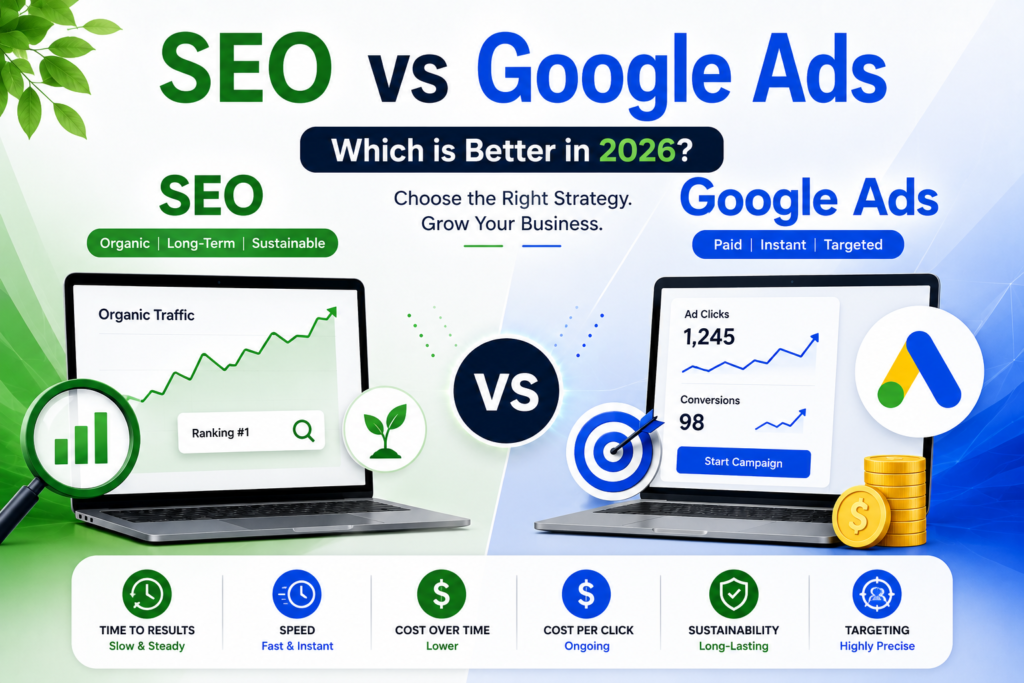
SEO vs Google Ads is one of the most searched digital marketing comparisons because every business owner wants the same outcome—more traffic, more leads, and higher revenue. After spending more than a decade helping businesses improve their online presence, I’ve seen companies invest heavily in the wrong marketing channel simply because they didn’t understand when SEO or Google Ads delivers the greatest value.
The reality is that there isn’t a universal winner. A local service business looking for immediate enquiries has different needs than an eCommerce brand aiming to build long-term organic visibility. Understanding the strengths, limitations, and return on investment of both strategies is essential before deciding where to invest your marketing budget.
In 2026, the landscape has become even more competitive. Google’s AI Overviews, evolving search algorithms, and increasing advertising costs have changed how businesses approach digital marketing. Relying on outdated advice is no longer enough. Today’s successful brands combine data-driven decision-making with a strategy tailored to their goals.
In this expert guide, you’ll learn the key differences between SEO and Google Ads, compare their costs and ROI, explore real-world use cases, and discover which approach is best suited to your business. Whether you’re a startup, a local business, or an established company, this guide will help you make a smarter marketing decision.
What is SEO?
Search Engine Optimization (SEO) is the process of improving a website so it appears higher in Google’s organic (non-paid) search results. Unlike paid advertising, SEO focuses on earning visibility by creating valuable content, optimizing website performance, and demonstrating authority and trustworthiness.
When users search for products or services, Google evaluates hundreds of ranking factors before deciding which pages deserve the top positions. Businesses that consistently publish high-quality, relevant content and provide a great user experience are more likely to rank well over time.
From my experience working with businesses across different industries, SEO isn’t about “gaming” search engines—it’s about creating the most helpful answer for the user. Websites that prioritize user intent, content quality, and technical excellence consistently outperform those relying on shortcuts.
The Three Core Pillars of SEO
1. On-Page SEO
On-page SEO involves optimizing the elements within your website, including:
- Keyword research and placement
- Title tags and meta descriptions
- Heading structure (H1–H5)
- Internal linking
- Image optimization
- User-focused content
- Search intent alignment
These optimizations help search engines understand your content while improving the experience for visitors.
2. Off-Page SEO
Off-page SEO focuses on building your website’s credibility and authority through external signals such as:
- High-quality backlinks
- Digital PR
- Brand mentions
- Guest posting
- Online reviews
- Local citations
A strong backlink profile remains one of the most influential ranking factors, particularly in competitive industries.
3. Technical SEO
Technical SEO ensures that your website is easy for search engines to crawl, index, and understand.
It includes:
- Website speed optimization
- Mobile responsiveness
- Core Web Vitals
- XML sitemaps
- Structured data (Schema Markup)
- HTTPS security
- Crawl error fixes
Even the best content can struggle to rank if technical issues prevent search engines from accessing it efficiently.
Why SEO Is a Long-Term Investment
One of the biggest advantages of SEO is that it continues delivering results long after the initial work is completed. A well-optimized page can generate traffic, leads, and sales for months or even years without paying for every visitor.
For example, one service-based business I worked with invested consistently in SEO for eight months. Although results weren’t immediate, organic traffic grew by over 180% within the first year, and the business began generating more enquiries from search than from paid advertising. This demonstrates why SEO is often viewed as a long-term asset rather than a short-term expense.
H2: What are Google Ads?
Google Ads is Google’s pay-per-click (PPC) advertising platform that allows businesses to appear at the top of search results almost immediately. Instead of waiting for organic rankings, advertisers bid on keywords and pay only when someone clicks on their ad.
This makes Google Ads an effective option for businesses seeking quick visibility, lead generation, or sales.
Unlike SEO, which builds authority over time, Google Ads provides instant exposure. However, that visibility lasts only as long as the advertising budget remains active.
How Google Ads Works
Google Ads operates through an auction system. Every time a user searches for a keyword, Google evaluates advertisers based on several factors, including:
- Maximum bid amount
- Ad relevance
- Landing page experience
- Expected click-through rate
- Quality Score
The highest bidder doesn’t always win. Businesses with highly relevant ads and optimized landing pages can often achieve better placements while paying less per click.
Types of Google Ads Campaigns
Search Ads
These are text-based ads that appear at the top of Google Search results when users search for specific keywords.
Display Ads
Visual banner advertisements shown across millions of websites within Google’s Display Network.
Shopping Ads
Ideal for eCommerce businesses, Shopping Ads display product images, prices, and reviews directly within search results.
Video Ads
These ads appear on YouTube and partner platforms, making them effective for increasing brand awareness and engagement.
Performance Max Campaigns
Google’s AI-powered campaign type automatically optimizes ads across Search, Display, YouTube, Gmail, Maps, and Discover using machine learning.
When Google Ads Makes the Most Sense
Google Ads is particularly effective when businesses need:
- Immediate website traffic
- Fast lead generation
- Product launches
- Seasonal promotions
- Local service enquiries
- Event registrations
- Time-sensitive campaigns
For example, if a plumbing company launches a same-day emergency service, waiting several months for SEO results may not be practical. Google Ads can place the business in front of potential customers searching for urgent solutions within hours.
SEO vs Google Ads: Key Differences
Although both SEO and Google Ads help businesses attract customers through Google Search, they operate in fundamentally different ways. Understanding these differences is essential for making informed marketing decisions.
| Feature | SEO | Google Ads |
| Traffic Source | Organic search results | Paid advertisements |
| Speed of Results | Medium to long-term | Immediate |
| Cost Structure | Investment in optimization and content | Pay-per-click (PPC) |
| Long-Term Value | Excellent | Stops when the budget ends |
| Brand Trust | Higher | Moderate |
| Scalability | Increases over time | Limited by advertising budget |
| Click-Through Rate | Often higher for informational searches | Strong for commercial intent |
| Best For | Sustainable growth | Quick visibility and conversions |
Why Choosing the Right Strategy Matters in 2026
The search landscape has evolved significantly. Google’s AI-powered search experiences, growing competition, and rising advertising costs mean businesses can no longer rely on a one-size-fits-all approach.
The most successful companies don’t ask, “Is SEO better than Google Ads?” Instead, they ask, “Which strategy aligns with our goals, budget, and growth stage?”
Choosing the right approach can reduce customer acquisition costs, improve marketing ROI, and create a sustainable pipeline of qualified leads.
Benefits of SEO
Search Engine Optimization is one of the few digital marketing strategies that continues to deliver value long after the initial investment. Unlike paid advertising, SEO helps businesses build a sustainable online presence by earning visibility rather than buying it.
Over the past decade, I’ve worked with businesses ranging from local service providers to growing brands, and one lesson has remained consistent: high-quality SEO compounds over time. A well-optimized website doesn’t just attract visitors—it builds trust, authority, and a steady flow of qualified leads.
1. Long-Term Organic Traffic
One of SEO’s greatest strengths is its ability to generate consistent traffic without paying for every click. Once your pages rank for relevant keywords, they can continue attracting visitors for months or even years with regular updates.
For example, a well-written blog targeting a high-intent keyword like “SEO vs Google Ads” can continue generating traffic long after it’s published, making SEO a long-term business asset.
2. Higher Trust and Credibility
Most users naturally trust organic search results more than advertisements because they perceive them as earned rather than paid.
When your website consistently appears on the first page of Google, it strengthens your brand’s authority and increases customer confidence before they even visit your site.
This trust often leads to:
- Higher click-through rates (CTR)
- Better engagement
- More enquiries
- Improved conversion rates
3. Better Return on Investment Over Time
SEO requires an upfront investment in content creation, technical optimization, and link building. However, as rankings improve, the cost per lead generally decreases because you’re no longer paying for every visitor.
Businesses that invest consistently in SEO often experience a lower customer acquisition cost over the long term compared to relying solely on paid advertising.
4. Supports Every Stage of the Customer Journey
SEO isn’t just about ranking for purchase-ready keywords. It allows businesses to create content for users at every stage of the buying journey:
Awareness Stage
Example:
- What is SEO?
- How does Google Ads work?
Consideration Stage
Example:
- SEO vs Google Ads
- SEO pricing
- PPC vs Organic Search
Decision Stage
Example:
- Best SEO agency
- Hire Google Ads expert
- Digital marketing services
By addressing all stages, SEO helps businesses attract and nurture potential customers before they’re ready to buy.
5. Improves Overall Website Quality
Effective SEO goes beyond keywords. It encourages businesses to enhance:
- Website speed
- Mobile usability
- Content quality
- Internal linking
- Navigation
- Accessibility
- User experience
These improvements benefit both search engines and visitors, creating a better overall experience.
Benefits of Google Ads
While SEO focuses on long-term growth, Google Ads excels at delivering immediate results. For businesses launching new products, entering competitive markets, or running seasonal campaigns, paid advertising can generate traffic and leads almost instantly.
1. Instant Visibility
One of the biggest advantages of Google Ads is speed.
Unlike SEO, which may take several months to build authority, Google Ads can place your business at the top of search results within hours of launching a campaign.
This makes it particularly valuable for:
- New businesses
- Limited-time promotions
- Product launches
- Emergency services
2. Highly Targeted Advertising
Google Ads offers precise targeting options, allowing businesses to reach the right audience based on:
- Location
- Language
- Device
- Search keywords
- Audience interests
- Demographics
- Time of day
This level of targeting helps maximize advertising efficiency and improve conversion rates.
3. Measurable Performance
One of the greatest strengths of PPC advertising is transparency.
Businesses can monitor key performance metrics, including:
- Clicks
- Impressions
- Conversion Rate
- Cost Per Click (CPC)
- Cost Per Acquisition (CPA)
- Return on Ad Spend (ROAS)
This data allows marketers to continuously optimize campaigns for better results
4. Flexible Budget Control
Google Ads allows businesses to control spending by setting:
- Daily budgets
- Monthly budgets
- Maximum bid limits
- Geographic targeting
Whether your budget is ₹500 per day or ₹50,000 per day, campaigns can be adjusted based on performance and business objectives.
5. Ideal for Testing New Markets
Before investing months into SEO, many businesses use Google Ads to test:
- Keyword demand
- Landing pages
- Offers
- Pricing
- Audience interest
The insights gained from PPC campaigns can later strengthen an SEO strategy by identifying high-converting keywords and user intent.
SEO vs Google Ads Cost Comparison
One of the most common questions business owners ask is:
“Which is more affordable—SEO or Google Ads?”
The answer depends on how you define cost.
SEO Costs
SEO typically includes investments in:
- Website optimization
- Content creation
- Technical SEO
- Link building
- SEO tools
- Ongoing maintenance
While these costs can be significant initially, the long-term cost per visitor often decreases as rankings improve.
Google Ads Costs
Google Ads charges advertisers each time someone clicks on their advertisement.
Costs vary depending on:
- Industry competition
- Keyword difficulty
- Quality Score
- Geographic location
- Audience targeting
Highly competitive industries such as legal services, finance, insurance, and digital marketing often have significantly higher cost-per-click (CPC) than less competitive niches.
Cost Comparison Table
| Factor | SEO | Google Ads |
| Initial Investment | Medium | Low to Medium |
| Ongoing Cost | Content & optimization | Pay for every click |
| Cost Per Visitor | Decreases over time | Remains ongoing |
| Long-Term Value | High | Depends on budget |
| Scalability | Excellent | Budget dependent |
Expert Insight:
Businesses with limited long-term budgets often benefit from investing in SEO because it creates a lasting source of traffic. Google Ads, on the other hand, is most effective when immediate visibility is the priority.
SEO vs Google Ads ROI Comparison
Return on Investment (ROI) should always be the deciding factor—not simply the amount spent.
When SEO Delivers Better ROI
SEO typically offers stronger long-term returns when:
- Building brand authority
- Creating evergreen content
- Targeting informational searches
- Growing organic traffic
- Reducing customer acquisition costs
Once your content ranks, every additional click is essentially free.
When Google Ads Delivers Better ROI
Google Ads often produces higher short-term ROI when:
- Launching new products
- Running seasonal promotions
- Generating immediate leads
- Testing marketing campaigns
- Targeting high-commercial-intent keywords
Because users searching with buying intent are often ready to convert, paid ads can generate sales quickly when campaigns are well optimized.
ROI Comparison
| Business Goal | Better Choice |
| Immediate Sales | Google Ads |
| Long-Term Growth | SEO |
| Brand Authority | SEO |
| Product Launch | Google Ads |
| Sustainable Leads | SEO |
| Fast Lead Generation | Google Ads |
| Maximum Overall ROI | SEO + Google Ads |
Which Businesses Should Choose SEO?
SEO is particularly effective for businesses focused on sustainable growth rather than short-term wins.
SEO is Ideal For:
- Local service businesses
- Educational websites
- SaaS companies
- Healthcare providers
- Digital marketing agencies
- Bloggers
- Content creators
- Professional service firms
- B2B businesses
These businesses benefit from consistent organic visibility and long-term lead generation.
Which Businesses Should Choose Google Ads?
Google Ads is often the better choice when businesses need immediate results or operate in highly competitive markets.
Google Ads is Ideal For:
- E-commerce stores
- Event organizers
- Product launches
- Restaurants
- Emergency services
- Seasonal businesses
- Real estate agencies
- Travel companies
- Businesses with time-sensitive offers
For these industries, waiting months for SEO may not be practical, making paid advertising an effective solution.
Real Business Case Study (Experience-Based)
One of the most valuable lessons I’ve learned over the years is that SEO and Google Ads are not competitors—they’re partners when used strategically.
A service-based business approached us with a goal of generating more qualified leads while keeping marketing costs under control. Instead of relying on a single channel, we implemented a combined strategy.
During the first month, Google Ads generated immediate enquiries and helped identify high-converting search terms. At the same time, we developed SEO-focused service pages, optimized technical performance, and published informative blog content targeting those proven keywords.
Within a few months, the business began gaining consistent organic visibility. As SEO performance improved, the reliance on paid advertising gradually decreased, allowing the company to reduce its overall customer acquisition cost while maintaining lead volume.
Key takeaway: Google Ads provided short-term momentum, while SEO built long-term growth. Together, they created a more balanced and sustainable marketing strategy than either channel could have achieved alone.
SEO vs Google Ads in the AI Search Era (2026)
The introduction of Google AI Overviews, AI-powered search experiences, and more sophisticated ranking systems has transformed digital marketing.
Today’s businesses must optimize for both traditional search results and AI-generated answers.
To succeed in 2026:
- Publish original, experience-based content.
- Demonstrate expertise and trustworthiness (E-E-A-T).
- Structure content with clear headings and FAQs.
- Answer search intent directly.
- Build topical authority through comprehensive content.
- Use structured data (Schema Markup) to help search engines understand your pages.
Businesses that combine high-quality SEO with targeted Google Ads campaigns are better positioned to capture visibility across both organic and paid search results.
Common Mistakes Businesses Make When Choosing Between SEO and Google Ads
Over the years, I’ve noticed that businesses rarely fail because they choose SEO or Google Ads—they fail because they implement the wrong strategy at the wrong time. Avoiding these common mistakes can save both time and marketing budget.
1. Expecting SEO Results Overnight
SEO is a long-term investment. While some improvements may be visible within a few weeks, competitive keywords often take several months to rank.
Businesses that abandon SEO after only two or three months usually miss the opportunity to achieve sustainable organic growth.
Expert Tip
Set realistic expectations. Focus on publishing high-quality content, improving technical SEO, and earning authority consistently.
2. Depending Only on Google Ads
Google Ads is excellent for generating immediate traffic, but the moment you stop paying, your visibility disappears.
I’ve worked with businesses that relied entirely on paid advertising. Their campaigns performed well, but rising cost-per-click (CPC) eventually made lead generation more expensive.
Building SEO alongside paid campaigns creates a more stable and cost-effective marketing strategy.
3. Ignoring Landing Page Optimization
Driving traffic is only half the job. Whether visitors come from SEO or Google Ads, a poorly designed landing page will reduce conversions.
A high-converting landing page should include:
- A clear headline
- Strong value proposition
- Fast loading speed
- Mobile-friendly design
- Customer testimonials
- Clear call-to-action (CTA)
- Simple contact form
4. Targeting the Wrong Keywords
Many businesses focus only on high-volume keywords while ignoring search intent.
For example:
- “Digital marketing” is broad and highly competitive.
- “Best digital marketing agency in Patiala” attracts users with stronger buying intent.
Understanding user intent often delivers better results than simply chasing search volume.
5. Measuring Traffic Instead of Revenue
More traffic doesn’t always mean more business.
The metrics that truly matter include:
- Qualified leads
- Conversion rate
- Customer Acquisition Cost (CAC)
- Return on Investment (ROI)
- Customer Lifetime Value (CLV)
Successful digital marketing focuses on business outcomes—not just website visitors.
Should You Combine SEO and Google Ads?
For most businesses, the answer is yes.
After managing campaigns for companies at different stages of growth, I’ve found that combining SEO and Google Ads often produces the strongest results.
Here’s why:
SEO Builds Long-Term Authority
SEO helps your business become a trusted source in your industry. As your content ranks for more keywords, you attract a steady stream of organic visitors without paying for every click.
Google Ads Delivers Immediate Results
While SEO is gaining momentum, Google Ads can generate leads, sales, and enquiries almost immediately.
Together, They Create a Smarter Strategy
A combined approach allows businesses to:
- Generate immediate traffic with Google Ads.
- Build long-term visibility through SEO.
- Test high-converting keywords using PPC data.
- Use those insights to create SEO content.
- Reduce customer acquisition costs over time.
- Increase overall search visibility.
Example Growth Strategy
| Business Stage | Recommended Strategy |
| New Business | 70% Google Ads, 30% SEO |
| Growing Business | 50% Google Ads, 50% SEO |
| Established Brand | 30% Google Ads, 70% SEO |
This balanced approach helps businesses achieve both short-term wins and long-term sustainability.
Expert Tips From 10+ Years of Experience
Digital marketing has evolved dramatically, but several principles continue to deliver results regardless of algorithm updates or advertising trends.
Create Content for People First
Google’s Helpful Content System rewards content that genuinely solves user problems.
Before publishing any page, ask:
“Does this content answer the user’s question better than competing pages?”
If the answer is yes, you’re moving in the right direction.
Prioritize Search Intent Over Keyword Density
Rather than repeating your focus keyword excessively, create comprehensive content that fully addresses the topic.
Modern SEO is about relevance, not repetition.
Invest in Technical SEO
Even outstanding content can struggle if your website has technical issues.
Regularly monitor:
- Core Web Vitals
- Mobile usability
- Page speed
- Broken links
- Crawl errors
- Structured data
Technical excellence supports better rankings and user experience.
Continuously Test and Optimize
Digital marketing is not a one-time activity.
Successful businesses regularly:
- Update existing content.
- Test new ad copy.
- Improve landing pages.
- Analyze conversion data.
- Refine keyword strategies.
Continuous improvement often produces better results than constantly creating new campaigns.
Frequently Asked Questions (FAQ)
Is SEO better than Google Ads?
Neither strategy is universally better. SEO is ideal for long-term growth and sustainable traffic, while Google Ads is better for immediate visibility and lead generation. The best choice depends on your goals, budget, and timeline.
Which is more affordable in the long run?
SEO generally provides better long-term value because organic traffic continues after your content ranks. Google Ads requires ongoing advertising spend to maintain visibility.
Can small businesses rely only on SEO?
Yes, but patience is essential. SEO can generate highly qualified leads over time, making it an excellent investment for businesses focused on sustainable growth.
Should startups invest in Google Ads?
For many startups, Google Ads is an effective way to generate initial traffic, validate offers, and attract customers while SEO efforts are developing.
Is combining SEO and Google Ads worth it?
In most cases, yes. Businesses that integrate both strategies often achieve stronger overall performance by balancing immediate results with long-term growth.
Final Verdict: SEO vs Google Ads in 2026
SEO vs Google Ads isn’t about choosing one winner—it’s about selecting the right strategy for your business objectives.
If your priority is immediate leads, product launches, or short-term campaigns, Google Ads offers unmatched speed and flexibility.
If you’re focused on building lasting brand authority, reducing customer acquisition costs, and generating sustainable organic traffic, SEO is the stronger long-term investment.
From my experience, the businesses that achieve the best results don’t treat SEO and Google Ads as competing strategies. They use paid advertising to create immediate opportunities while investing in SEO to build a long-term digital asset that continues delivering value year after year.
As search continues to evolve with AI-powered experiences and increasing competition, businesses that combine both strategies—supported by high-quality content and a technically optimized website—will be best positioned for long-term success.